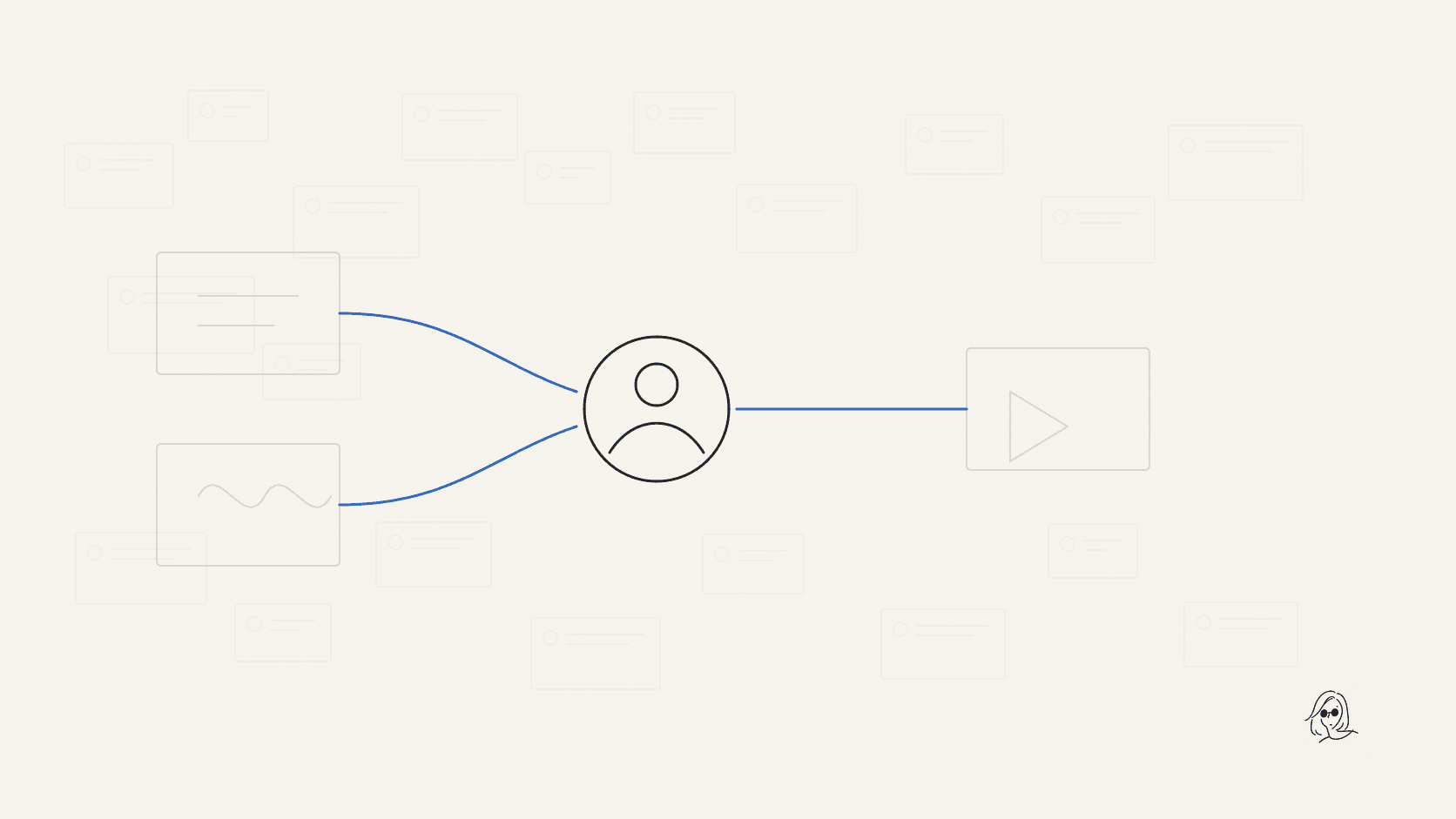
My career can look a little discontinuous.
I have worked in writing, audio and video, and I have run my own accounts. Later, I went back to school and began building AI products. Put the job titles in chronological order and the obvious conclusion is that I changed careers from content to product.
But I do not see it that way.
I did not leave content in the past. It moved from being the final deliverable to becoming one of the ways I understand people.
Every medium was training the same ability
When I write an article, I ask where a reader will pause. Which sentence will make them feel, “This is about me”? In what order must a complicated idea unfold before it becomes easy to understand?
In audio, the problem changes. Without an image, how can a voice accompany someone through a commute? Which tone creates distance, and which pause invites them to keep listening?
Video compresses the user’s patience further. Scene, rhythm, a person’s presence and platform distribution all work at the same time. If a piece is not seen, the idea may not be weak. It may simply have failed to create a relationship in the first few seconds.
On my own accounts, the feedback is even more direct. Titles, images and expression eventually become real saves, comments, follows and commercial collaborations. A creator cannot hide behind a division of responsibility. Why people arrive, leave or send something to a friend always leaves evidence.
The media are different, but they train the same sensitivity: stand on the receiving side and observe how a person notices, understands, trusts and eventually acts.
Product extends understanding from one piece of content into a journey
When I began building products, many of the questions felt familiar.
A first screen behaves like a headline: it has very little time to explain what something is. Onboarding behaves like the opening of an article: it cannot tell the user everything at once. The rhythm of a conversation resembles an interview: you need to know when to ask, when to follow up and when to stop. Growth content does more than bring a click. It shapes what the user expects the product to deliver.
The difference is that content can often finish at “being understood.” Product has to keep asking: what happens after understanding?
Did the user complete the first action? Did they receive a result they could feel? Is there a reason to return tomorrow? Can the path be repeated, or did it depend on one beautiful piece of expression?
Product work also forced me to see the limits of content. A widely shared idea may not solve a real problem. An emotionally effective message may attract the wrong people to a product. Click-through can prove that the expression worked. It cannot prove the product’s value.
Content experience does not automatically make someone a product manager. Metrics, systems, cost, technical constraints and long-term tradeoffs all require separate learning. The intuition that “I understand users” can also turn one person’s preference into an imagined universal need.
But content gave me an important starting point: I habitually try to understand a person before I begin building.
I did not escape content for technology
I once returned to school because I wanted to understand the “black box” of recommendation systems. At the time, I thought I had to cross to the product and technical side before I could move the work I cared about.
Later I realized that the value was not replacing my old language. It was being able to hold two languages at once.
I can hear users when their stories are incomplete, emotional or contradictory, then organize those stories into structures, assumptions and paths that can be tested. I care whether a sentence can move someone, and I also care whether the product can receive them after it does.
Content is therefore not an old section of my résumé, and product is not a total reinvention.
There has always been one clear thread between them: I want to understand what a person is experiencing, then turn scattered information into something they can understand, use and continue with.