When I began leading a growth experiment for Fanshu Intelligent Edition, I moved quickly.
I contacted a group of Xiaohongshu book creators and arranged product-access and merchandise exchanges. The recommendation feed soon filled with different interpretations of the product. Some creators treated it as immediate support for parenting questions. Some valued efficient listening and note organization. Others used the AI conversation for emotional support.
In terms of content execution, the collaboration went smoothly.
But when I put registration, use and return behavior together, the answer was not “find more creators.”
The channel brought people in, but could not keep them for the product
In the final analysis, 77 creators could be identified accurately and included in behavioral analysis. The campaign brought in roughly 100 to 130 new users.
More importantly, next-day retention was only 18.2%.
What we could say with confidence was that content had been published and registration had happened. Continued use had not followed.
This made me realize that the immediate problem was not a lack of one-time traffic. In this experiment, the channel had done its job: people became aware of the product, felt interested and were willing to try. Increasing the number of collaborations might create more exposure, but it would not automatically change what happened the next day.
A distribution campaign can also be user research
The experiment was not without value.
We did not ask every creator to repeat the same set of selling points. We let them experience the product and choose what they genuinely wanted to talk about. Their content naturally gathered around three situations: immediate help with parenting, using knowledge from books more efficiently, and feeling emotionally supported during relationship or career uncertainty.
This language was closer to users than the feature descriptions a team might write in a meeting room.
Creators were not only distribution nodes. They were also early users who entered the product carrying specific problems from their lives. They showed us which value was easy to understand and which features people wanted to explain. Behavioral data then answered a different question: which messages were easy to talk about, and which could actually become use?
Listening to books appeared to create more self-directed use than AI conversation. That alone does not prove long-term retention, but it suggested that a familiar, low-friction behavior can enter daily life more easily than a feature that merely looks new.
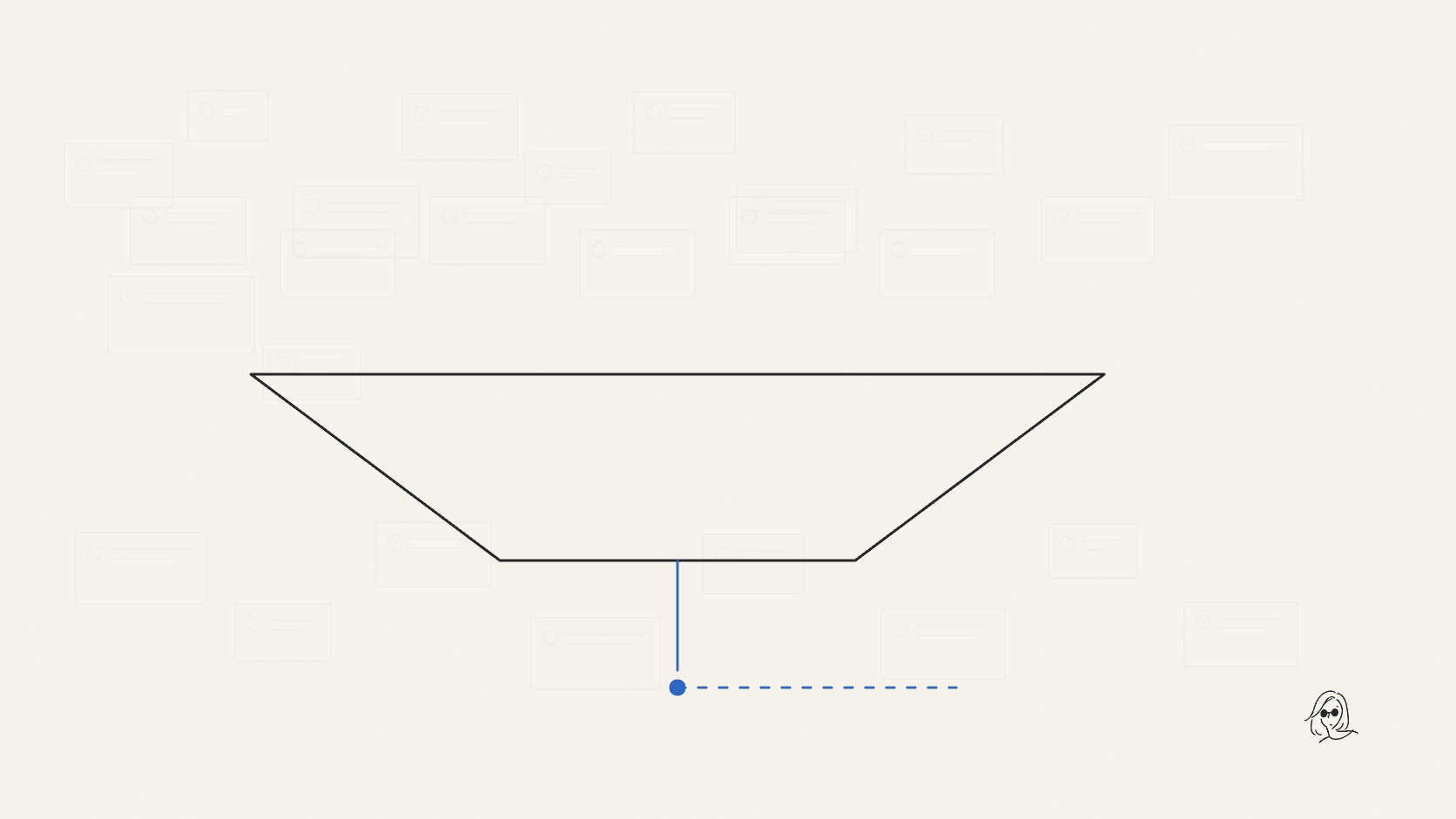
Growth is not making the top of one funnel larger
My content background trained me to look first at distribution. Is the topic strong? Is the expression attractive? Are the partners a good fit? After this experiment, I saw growth more clearly as one continuous product path.
What expectation did the content create, and did the first experience fulfill it? What did the user receive before leaving? Why would they return tomorrow? Did a shared link bring in someone who completed one task, or someone who began using the product for themselves?
If any part fails to receive the user, more volume upstream can simply create faster loss.
This does not mean the channel failed. The collaboration showed that an exchange model could create content density and helped the team extract more natural user situations. The point is simply that an effective channel is not proof of an effective product.
My responsibility in this company-level product was the external growth experiment, not the whole Fanshu Intelligent Edition. After the experiment, I continued to participate in improvements to visual design, interaction, note capture and AI conversation. The important change for me was no longer treating “how many people arrived” as the endpoint. I kept asking: how many of them had a reason to remain?
Sometimes the most valuable result of a growth experiment is not proof that the next campaign should be larger.
It is an early signal that the thing that needs fixing is not traffic.